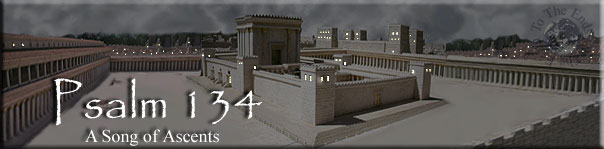
At Night in the Temple
The evening
sacrifice in the Temple was actually performed in the late afternoon, at about 3 pm. After that, at about sunset, the great gates of the Temple were closed to ordinary worshippers. But inside the gates, many priests and Levites remained, who were on guard in the Temple throughout the night. It’s not clear whether the worship mentioned in this Psalm refers to prayers or blessings offered up by these night guards, or perhaps to times of festival, when worship in the Temple continued longer than usual (Isa. 30:29). In either case, the focus of the Psalm is on blessing God in his Temple, and receiving his blessing in return.
Click this box for the Historical Notes
Psalm 134
Look!
[pause]
[1] Bless# Yehuah
All you# servants of Yehuah
Who stand in the House of Yehuah
At night.
[pause]
[2] Lift up your# hands of holiness
And bless Yehuah.
May Yehuah bless you* from Zion,
The maker of heavens and earth.
POETIC STRUCTURE ANALYSIS
Like many songs today, the Psalms were poetry put to music. But unlike Western poetry, Hebrew poetry is based on parallel thoughts set beside one another. These parallels can be a restatement of the same idea (synonymous parallelism), present opposing ideas (antithetic parallelism), or be in some other relationship, such as chiasm (A, B, B', A'). These parallels are then grouped in sections (strophes) that are arranged to give structure and meaning to the poem.
This Psalm is made up of only two strophes [sections]. In the original Hebrew, it has a two beat (two major accent) rhythm in five of its first six lines (or half-lines as they are printed in the Hebrew text).
The song begins with the interjection, Look!
(or “behold”). This is outside its poetic structure, as is indicated in the Hebrew text by a vertical line separating it from the rest of the psalm. This may have been to focus the attention of those singing, as with the words Hallelu Yah
at the beginning of Psalm 135.
The first strophe (which has the pattern A, B, B', C) is an exhortation to those in the Temple at night, that they should bless God during their time of service there (see Historical Notes). The shortness of the lines gives added emphasis to the repetition of the name of God (Yehuah). Servants of Yehuah
is a parallel to those who stand [for prayer] in the House of Yehuah.
The fourth line of this strophe, In the night,
breaks the rhythmic pattern, which creates a pause.
The second strophe (which also has the pattern A, B, B', C) expands on the idea of standing to bless God by including the action of lifting up the hands for this blessing. Standing with hands raised was a standard position of prayer in the Biblical period (see Historical Notes). It was also used for pronouncing a blessing, as is still done today in the priestly blessing. This priestly blessing (Num. 6:24-26) is alluded to in the last two lines. The parallel thought in the two halves of this strophe is pronouncing a blessing: in the first half by the worshippers, in the second half by the speaker, who is pronouncing a blessing in the name of the Lord.
The contrast between the two distinct yet parallel blessings mentioned in the second strophe is made by changing the personal pronoun from the plural in the first two lines to the singular in the last two lines. This is accompanied by a shift in the rhythmic pattern from two to three beats (three major accents). This shift is reflected in the translation by the addition of a vertical space between the two halves.