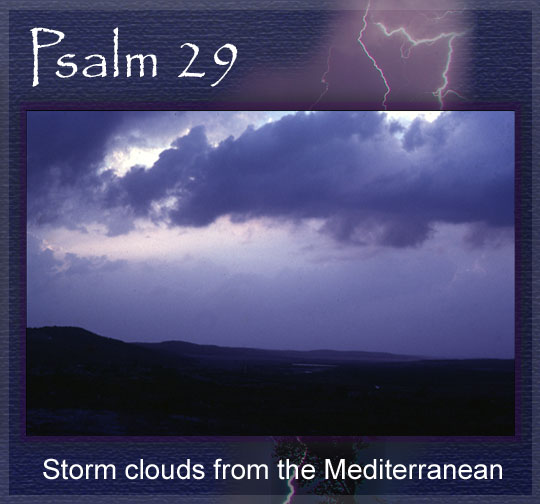
God’s power revealed in a storm at the time of the winter rains
In the time of Jesus (Yeshua), this psalm was sung in the Temple at the time of the afternoon sacrifice of the Feast of Trumpets (Yom Teruah, today’s Rosh HaShanah). It’s a symbol of the approaching presence of God in the High Holy Days of the sacred seventh month of Tishri as well as of the approaching winter rains. It was also sung on the second day of the Feast of Tabernacles (Sukkoth) and in the weekly welcoming of the Sabbath (Kabbalat Shabbat).
Click green links with arrows for photos.
Click this box to go to the Historical Notes
Psalm 29
[1]
Credit to Yehuah, sons of the gods,
Credit to Yehuah glory and strength.
Credit to Yehuah the glory of his name.
Prostrate yourselves before Yehuah in the splendor of holiness.
[pause]
[2]
The voice of Yehuah is over the waters.
The God of glory thunders ⇩,
Yehuah, over many waters:
The voice of Yehuah in power,
The voice of Yehuah in splendor,
[3]
The voice of Yehuah, breaker of cedars.
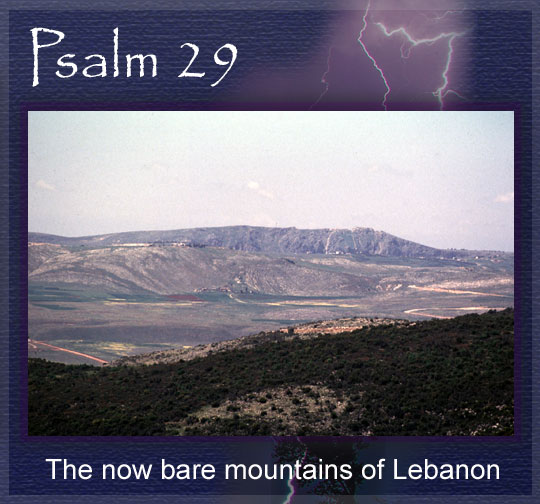
And Yehuah breaks the cedars of Lebanon ⇩.
And he causes them to leap as a calf, Lebanon
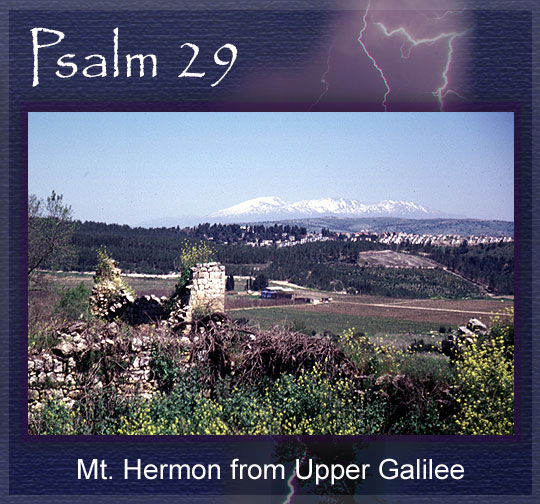
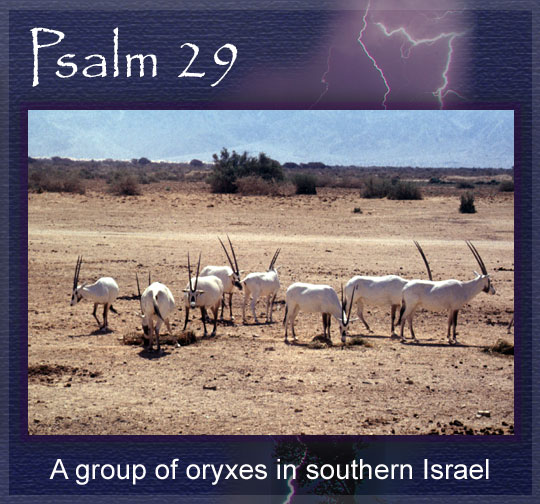
And Sirion ⇩, as the offspring of oryxes ⇩.
The voice of Yehuah, hewer of blades of fire.
[4]
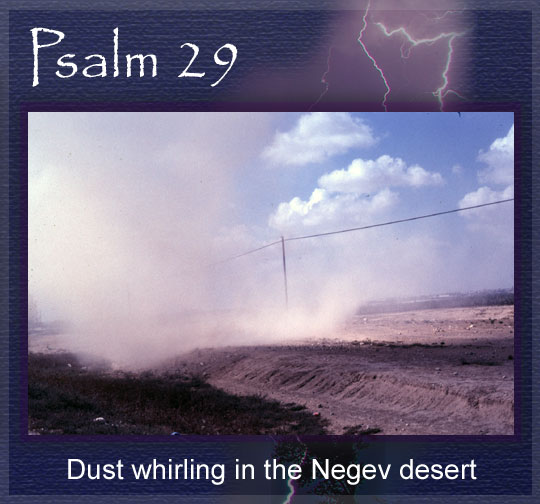
The voice of Yehuah causes the desert to whirl ⇩.
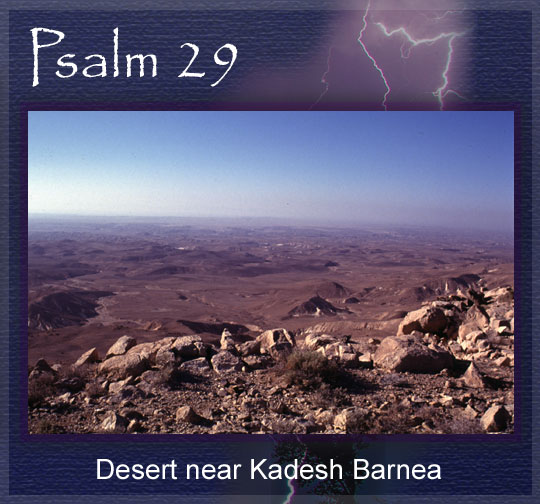
Yehuah causes the desert of Kadesh ⇩ to whirl.
The voice of Yehuah causes the deer to writhe
And he strips bare the forests.
And in his sanctuary, everything speaks glory.
[pause]
[5]
Yehuah sat as king for the Flood
And Yehuah sits, king forever.
Yehuah will give strength to his people.
Yehuah will bless his people with peace.
POETIC STRUCTURE ANALYSIS
Like many songs today, the Psalms were poetry put to music. But unlike Western poetry, Hebrew poetry is based not on rhyme and meter, but on parallel thoughts set beside one another. These parallels can be a restatement of the same idea (synonymous parallelism), present opposing ideas (antithetical parallelism), or be in some other relationship, such as chiasm (A, B, B', A'). These parallels are then grouped into sections (strophes) that are arranged to give structure and meaning to the poem.
This psalm breaks logically into five strophes. The first and the last concern the glory and majesty of Yehuah as the divine king. They mirror one another in that each uses the name of Yehuah four times and share nearly the same poetic pattern of synonymous parallels, though the lengthened end of the first strophe breaks the rhythm and introduces a pause.
The 2nd and 4th strophes also mirror one another. Both are made up of a three line element and a two line element, each of which begins with the words the voice of Yahueh.
The 2nd strophe begins with a three line element which is followed by a two line element (A, A, A, B, B). The 4th strophe is its mirror opposite, with a two line element followed by a three line element. The irregular construction of the 4th strophe (A, A, B, B, C), however, by breaking the pattern, introduces a pause. The mention of God’s sanctuary in the last element (C) serves to transition back to the theme of God’s personal glory in the final strophe.
Both stropes 2 and 4 use the imagery of a storm to speak of God’s dominion: in the 2nd strophe over the waters of the earth, while in the 4th strophe over the deserts in the south and the forests in the north.
The 3rd strophe is the climax of the poem, in which the thunder of God is now matched with his crashing lightning, breaking the mighty cedars of Lebanon in the mountains to the north, which causes the inhabitants of Lebanon and Mt. Hermon to jump with fright, like animals frightened by a crash of lightning.
The overall pattern of the poem, therefore, counting by strophes, is a classic chiastic pattern: A, B, C, B', A'.
The speaker, by referring to God’s majesty in the storm and the crashing of lightning, calls the gods of the nations to submit to the awesome power and authority of Yehuah, a God who provides strength and blessing to his people.