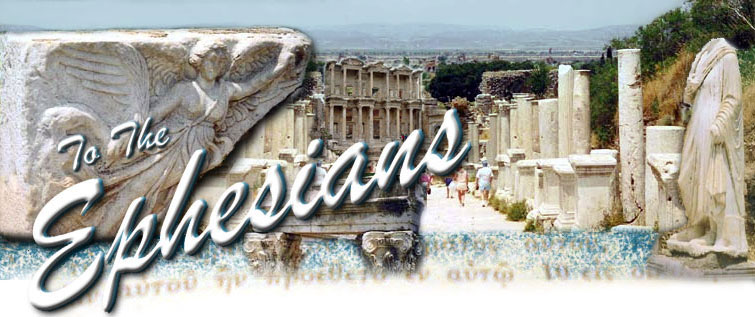
Paul explains God’s vision for Jews and Gentiles together in the Body of Messiah
A literal translation from the Greek by Jeffrey J. Harrison. You can also print out this translation as a booklet
1 1 Paul, an apostle of Messiah Jesus by the will of God, to the holy ones who are in Ephesus,
who are also faithful in Messiah Jesus:
2 Grace to you# and peace from God our Father and Lord Jesus the Messiah.
3 Blessed be the God and Father of our Lord Jesus the Messiah,
the one [the Father] who has blessed us with every spiritual blessing in the heavenlies by means of Messiah,
4 for he has chosen us in him [in Messiah] before the foundation of the universe,
that we might be holy and blameless before him [the Father] in love,
5 for he predestined us for adoption to him through Jesus the Messiah, according to the desire of his will,
6 that it might result in the praise of the glory of his grace,
the same grace with which he [the Father] graced us by means of the beloved [Jesus],
7 in whom we have redemption through his blood—that is, the forgiveness of sins—according to the riches of his grace,
8 which same grace he gave to us in abundance in all wisdom and understanding
9 when he made known to us the mystery of his will,
according to his desire, which he publicly put forward in him [in Messiah],
10 that the administration of the fullness of the times [the end times] will bring all things under one head [one ruler]
in the Messiah, both the things in the heavens and the things on the earth;
in him,
11 in whom we [Jewish believers in Jesus] have also been chosen by sacred lot,
having been predestined according to the plan of the one working all things according to the counsel of his will,
12 that we, the first to hope in the Messiah, might be to the praise of his glory;
13 in whom you# [Gentile believers in Jesus] , too, after you# heard the word of truth—the good news of your# salvation—
in whom you,# too, after you# believed, were sealed with the Holy Spirit of promise,
14 who is a down payment to us of our inheritance
toward the redemption [liberation or setting free at Messiah’s return] of the possession [the church], that it might result in the praise of his glory.
15 For this reason, and because I have heard of your# faith in the Lord Jesus and your# love there among all the holy ones [in Ephesus], 16 I do not stop giving thanks when I make mention [make a remembrance] of you# in my prayers
17 that the God of our Lord Jesus the Messiah, the Father of glory, may give you# a spirit of wisdom and revelation in your# knowledge of him, 18 now that the eyes of your# heart have been enlightened,
that you# may know
what is the hope of his calling,
what are the riches of the glory of his inheritance among the holy ones, 19 and
what is the surpassing greatness of his power in us who believe,
a power that matches the action of the intensity of his might, 20 which he made active in the Messiah when he
raised him from the dead, and
seated him on his right in the heavenlies 21 above every ruler and authority and power and dominion and every name that is named, not only in this age, but also in the age that is about to appear, 22 and
put all things in subjection under his [Messiah’s] feet
[Psalm 8:6], and
made him [Messiah] to be the head over the entire church, 23 which is his body, the fullness of the one filling all [in the church] with all things.
NOTES
1:1 Paul: Paul, originally named Saul, was born into a Jewish family in Tarsus of Cilicia (modern southeastern Turkey). He came to faith in Jesus as the Messiah while traveling to Damascus to persecute Jewish believers in Jesus in that city. By the time he wrote this letter, he had already preached the gospel from Israel as far as Greece. But during a visit to Jerusalem, he was arrested by the Roman authorities. The charge brought against him by Jewish officials was that he had violated the sanctity of the Jewish Temple in Jerusalem. They claimed he had brought Gentiles into areas restricted to Jews (see below Eph. 2:14 and note). During his trial, Paul appealed his case to Caesar (the Roman Emperor). As a result, he was taken as a prisoner to Rome. At the time of writing this letter, he was under house arrest in an apartment in Rome, awaiting trial before Caesar. ⏎
1:1 Apostle: From a Greek word meaning someone sent on a mission.
The Jewish Sanhedrin Council (the Jewish Supreme Court) sent word of its decisions to Jews living outside of Israel by means of apostles (or emissaries). The apostles of Jesus were sent with the gospel of salvation first to Jerusalem and nearby provinces (Judea and Samaria) and then to the ends of the earth
(Acts 1:8). ⏎
1:1 Messiah: The Anointed One.
Pouring oil on the head (anointing) was a Hebrew custom to show that an individual was chosen and given the ability by God to fill a certain position. The Old Testament records the anointing of kings, priests, and prophets. Later, the Anointed
was used as a title for the coming deliverer mentioned by the prophets. The anointing of Jesus was poured out by God at the time of his baptism, when the Holy Spirit descended on him in the form of a dove (Matthew 3:16-17). For an explanation of the use of Messiah
rather than the traditional Christ,
see the Introduction. ⏎
1:1 Jesus: This English form of his name is derived from the Greek form (Iesous) of his original Hebrew name Yeshua (ye-SHU-ah), which means salvation.
Jesus’ disciples knew him and referred to him by this Hebrew name. ⏎
1:1 The holy ones: Refers to those who have been set apart
from the world (made holy) for the sake of Messiah—the calling of all true believers. ⏎
1:1 Ephesus: The chief city of the Roman province of Asia. This province included most of modern southwestern Turkey. Ephesus had been an important coastal city for hundreds of years. It was well known for its temple of the Greek goddess Aphrodite just north of the city. Her devotees once forced Paul to flee the city (Acts 20:1). Paul first visited Ephesus during his second missionary journey (Acts 18:19-21). A year or so later he returned to found a church, which he served as pastor for two years (Acts 19:10). This letter was written from prison in Rome about seven years later. Although the name Ephesus
does not appear in all the ancient copies of this letter, this was the generally accepted destination according to early Christian writers. ⏎
1:1 In Messiah Jesus: Everyone who is in Messiah
is a member of his spiritual body, just as a cell is part of a physical body. This is the Hebrew idea of collective personality. Israel,
for example, can refer either to the son of Isaac or the nation of his descendants. In the same way, Messiah
can refer either to Jesus personally or to the community of those who believe in him, including himself as its head. Throughout this letter, in Messiah
refers to this spiritual position of believers in the body of Messiah. ⏎
1:2 You#: Each pronoun in the second person is marked to indicate whether it is singular or plural in the original language. A pound sign (#) is used for plural, an asterisk (*) for singular. ⏎
1:2 Lord: In Greek, Lord
(Kyrios) was used to translate the personal name of God (Yhwh in Hebrew). By calling Jesus Lord,
Paul and other early Greek-speaking believers declared that Jesus shared the divinity of God, and was himself God. This is why confessing Jesus as Lord is essential to salvation: it is a confession that he is God (God the Son; Romans 10:9). ⏎
1:3 Blessed: Paul’s introductory blessing is a single sentence from verse 3 to verse 14. The original structure has been preserved here and throughout the letter. ⏎
1:4 Foundation of the universe: The creation. ⏎
1:9 Mystery: The hidden will of God which has been disclosed through his prophets. This letter is itself largely the record of a revelation received by Paul of God’s plan for the equal participation of both Jews and Gentiles in the body of Messiah (see below Eph. 3:3-7). ⏎
1:10 Fullness of the times: This phrase describes the passage of time as a vessel filling with water, as could be seen in the water clocks of ancient times. When the vessel was full, the appointed time had come. The fullness of the times
is therefore similar to the expression the end times
or the last days.
God’s plan for this final period is for the Messiah to rule over both the heavens and the earth. The reign of Messiah began with his ascension and enthronement (Acts 2:33-35) and will eventually bring all things into subjection to him (1 Cor. 15:25-28). ⏎
1:11 Jewish believers in Jesus: Although Paul does not state it here directly, the context clearly shows that we
(the first to hope in Messiah,
Eph. 1:12) are Jewish believers in Jesus as the Messiah. At the time Paul was writing, the church was still mostly Jewish. There was much uncertainty as to how or if Gentiles should be included. In this letter, Paul explains God’s plan for the inclusion of Gentile believers in the Church (see below Eph. 3:3,5-6). ⏎
1:11 Lot: A marked stick, bone, or other object that was thrown to determine the will of God. The answer was taken from the marking on the side facing up (Proverbs 16:33, 18:18; Matthew 27:35; Acts 1:26). Here Paul uses the lot to describe God’s selection of the Jewish people, among whom Messiah was revealed, and from whom the first believers were chosen. ⏎
1:13 Gentile believers in Jesus: Non-Jewish believers. Paul clearly states that the you
he addresses in this letter are Gentile believers in Jesus (Eph. 2:11, 3:1). The church in Ephesus must have been largely if not entirely Gentile. ⏎
1:13 Sealed: The sealing of the Holy Spirit is the imparting of the Spirit into the life of the believer, which serves as a sign (a mark or seal) of the believer’s participation in the body of Messiah (2 Corinthians 1:22, Ephesians 4:30, Revelation 7:3). ⏎
1:13 Holy Spirit of promise: Luke 24:49; Acts 1:4, 2:33,39; Galatians 3:14. ⏎
1:14 Down payment: The Holy Spirit in us is a pledge of the eternal life to come—our inheritance
—which will be revealed at our redemption
when Messiah returns. ⏎
1:14 The possession: Refers to the special relationship between God and his chosen people (Exodus 19:6, 1 Peter 2:9). The redemption of the possession
refers to the setting free of God’s people from the afflictions of Satan and the world at Messiah’s return (2 Thess. 1:7). ⏎
1:23 The fullness of the one filling all with all things: Since the body of Messiah is made up of believers, we are his fullness
or completion (the body of Messiah would be empty without us). But at the same time, he is our fullness, filling
each of the members of the body with the wisdom, revelation, power, and other blessings that Paul has been talking about (see Eph. 3:19 below). ⏎